A major transformation in radiology reporting technology
The status quo: Narrative reporting
Radiology reporting today is still dominated by free-text, narrative reports. Radiologists dictate their findings and produce a report that is distributed across the clinical ecosystem.
This approach has been the standard for decades because it is fast, flexible, and closely aligned with how radiologists work in high-throughput environments. It allows clinical articulation, avoids rigid structures, and enables efficient but complete documentation even in complex cases. In that sense, narrative reporting reflects how the radiology reporting workflow has been optimized over time for speed and usability at the point of creation.
At the same time, this optimization comes with a structural limitation. The report is designed primarily for the radiologist creating it, not for the broader set of users and systems that depend on it afterward.
As long as reporting was mainly about communicating findings from one physician to another, this trade-off was acceptable. But the role of the radiology report has expanded significantly.
One report, many stakeholders
A single radiology report now serves a wide range of stakeholders, each with fundamentally different expectations. An oncologist is interested in how findings evolve over time and how they relate to treatment response. A surgeon needs precise localization and contextual detail to plan an intervention. A referring physician looks for a clear and concise summary to support immediate decision-making, while patients increasingly expect understandable and transparent information.
In addition, other radiologists, tumor boards, registries, and downstream systems all rely on the same report as a source of truth.

This creates a fundamental mismatch. Free-text reports attempt to serve all of these needs simultaneously, but in practice they require each reader to extract, interpret, and reframe the information for their specific use.
What is efficient and flexible for the radiologist becomes inefficient and inconsistent for everyone downstream. The report remains a static narrative that does not adapt to different contexts, cannot easily be compared across time, and is difficult to integrate into modern radiology reporting platforms and data-driven workflows.
What future radiology reports need to deliver
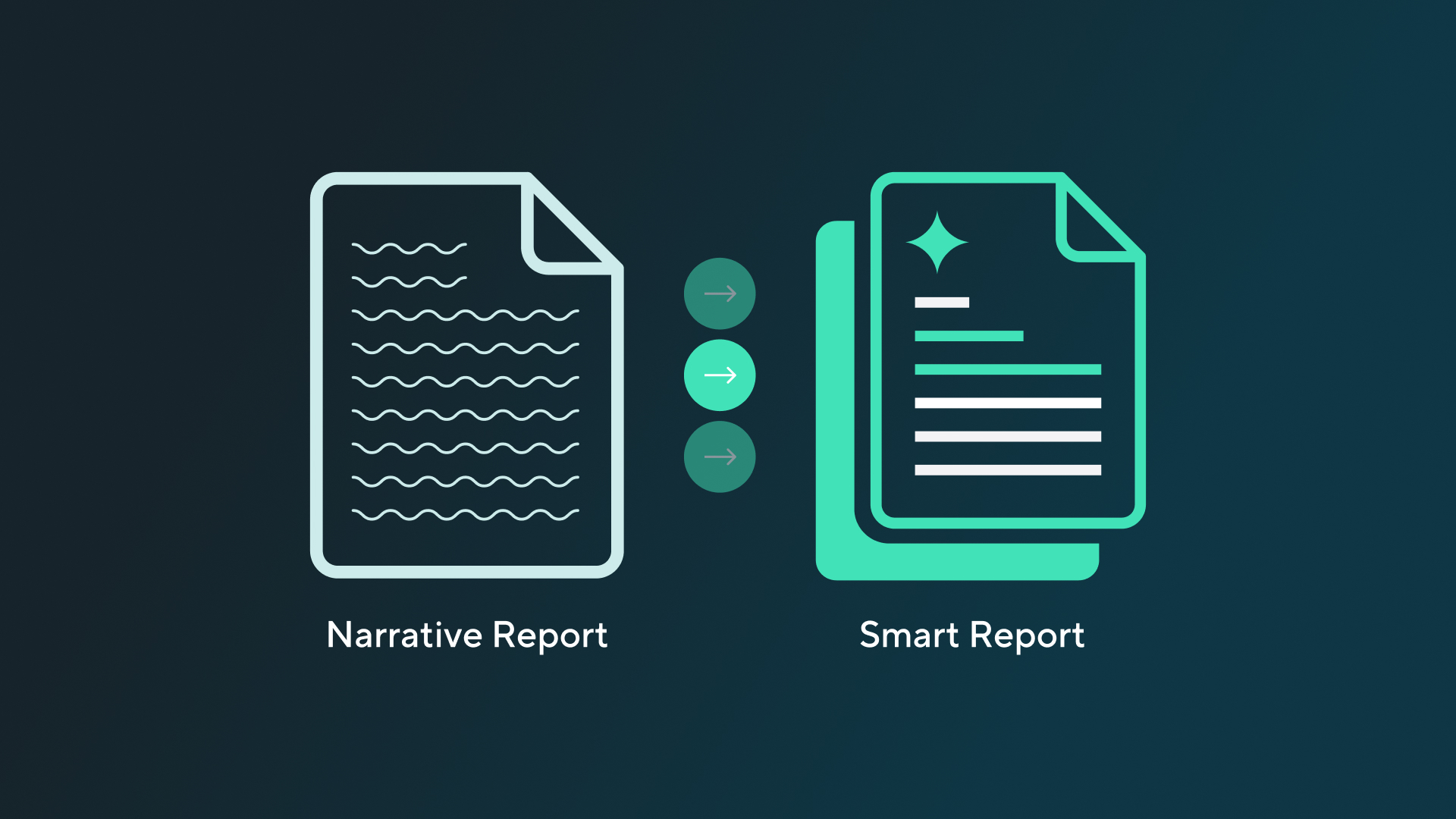
As radiology becomes more data-driven and AI-enabled, reporting needs to evolve beyond narrative documentation - not by replacing it, but by extending it. Traditional reports rely on descriptive free text, manual interpretation, and copy-pased misuse. This limits traceability and makes integration with AI systems and clinical workflows difficult. In contrast, future reports combine narrative interpretation with structured evidence. They integrate AI-generated outputs, measurements, and longitudinal data alongside explicit clinical context, assumptions, and standardized concepts.
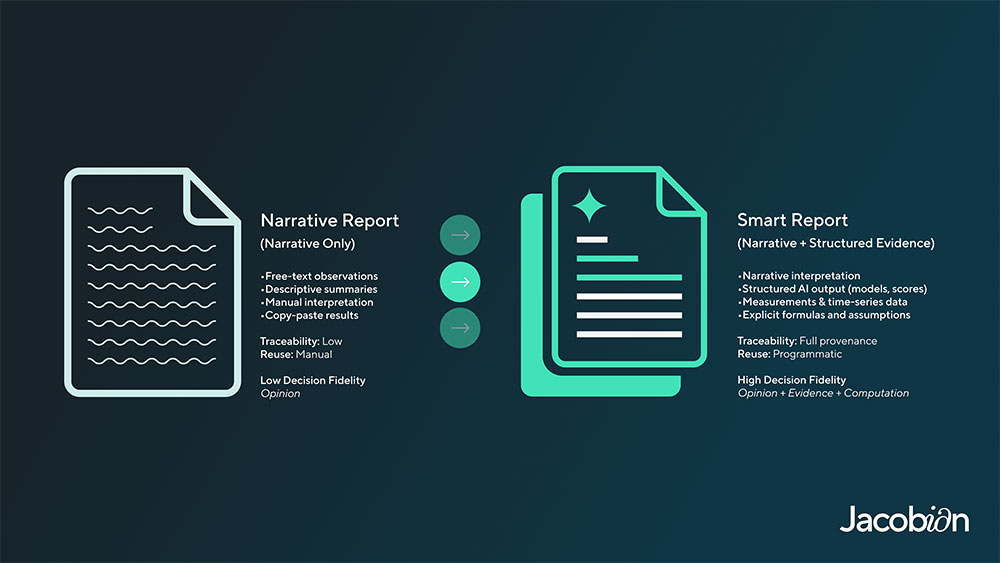
This shift is also closely linked to emerging forms of AI-powered reporting, where clinical context, automation, and decision support are increasingly embedded directly into the reporting process.
This changes the role of the report fundamentally. Instead of being a static document, it becomes a data-connected system of record that supports traceability of findings and decisions, programmatic reuse across workflows, and consistency over time and across institutions.
Measurements can be tracked longitudinally, AI outputs can be embedded and validated, and clinical reasoning becomes more transparent and reproducible. These capabilities are also enabling new levels of radiology report automation, particularly in areas such as follow-up tracking, structured comparisons, and workflow integration. For organizations evaluating modern reporting solutions - especially in the context of a potential migration to a new platform - this capability is central.
The value of reporting is no longer only defined by how efficiently it is created, but by how effectively it supports downstream clinical decisions, workflows, and analytics.
Ultimately, this transformation marks the shift from narrative reports to evidence-based documentation and lays the foundation for a next-generation reporting platform that can evolve from intelligent assistance to full workflow orchestration.
About the author
Wieland Sommer

Founder and Chief Strategy Officer, Jacobian