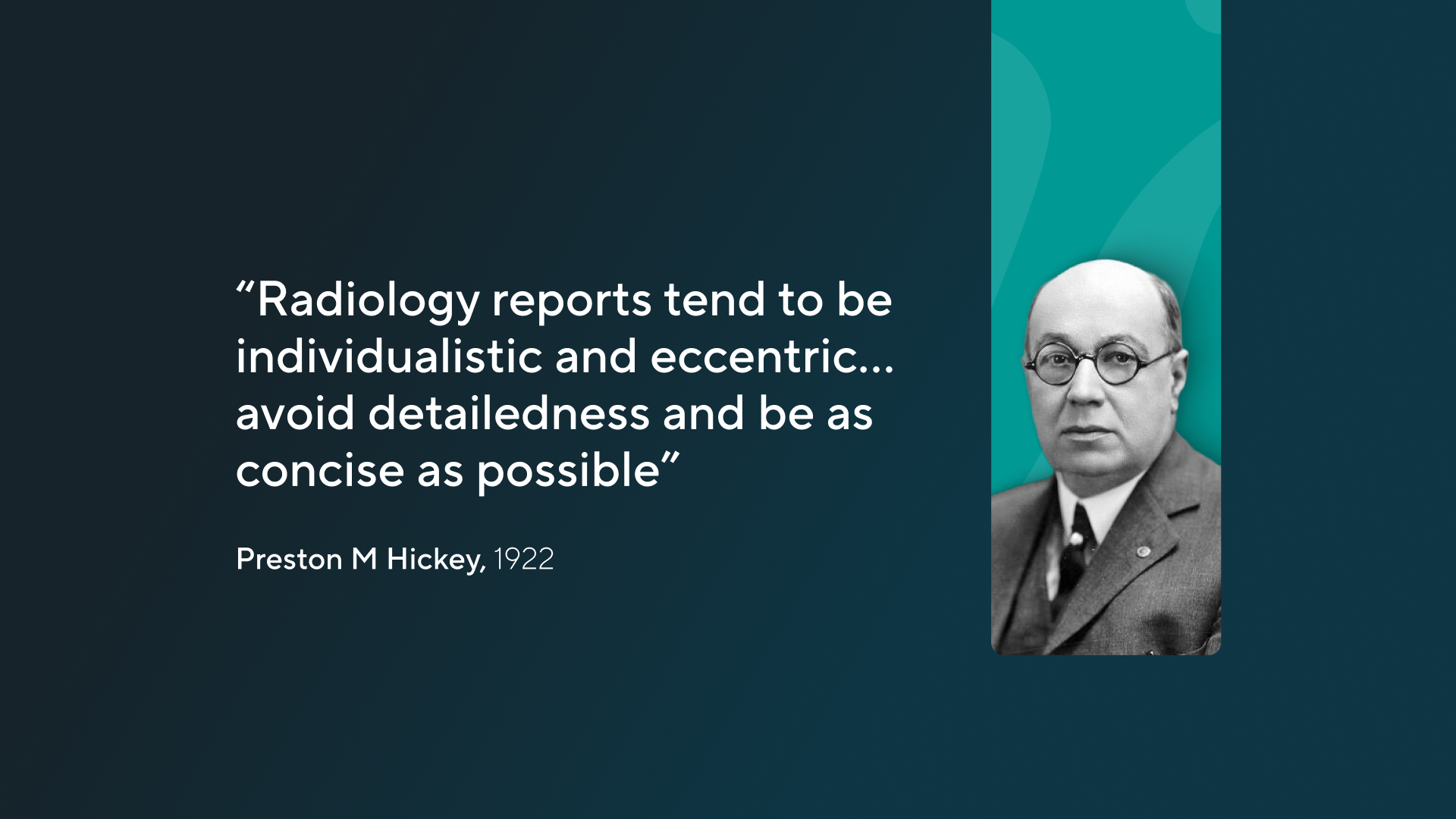
More than a century ago, radiologist Preston Hickey warned that the clinical value of imaging ultimately depends on the quality of the radiology report. He observed that reports were often ambiguous and difficult for clinicians to interpret - a concern that still feels surprisingly familiar today.
For most of the past hundred years, however, the report itself changed very little. Radiology evolved rapidly-from film to PACS, from CT to high-resolution MRI, from analog archives to fully digital environments-yet the report remained largely the same: dictated narrative text, delivered as a static document.
That long period of stability is now ending.
Generative AI, modern data models, and increasing workflow complexity are opening new possibilities for how reports can be created and used. At the same time, the announced sunset of [AP1] a legacy product is prompting many radiology departments to reassess their reporting systems. This is no longer just a replacement cycle-it is a moment of broader rethinking.
It raises a fundamental question: what role should the radiology report play in the future of diagnostic medicine?
Where today's radiology reporting workflow is most painful
When inefficiencies in radiology reporting are discussed, the focus is often on dictation or typing. In practice, these are rarely the main bottlenecks. The real friction lies in fragmented workflows - switching between systems, searching for prior exams, integrating AI outputs, checking guidelines, and ensuring consistency. These interruptions increase cognitive load and slow down decision-making.
Reporting sits precisely at the point where all of this comes together. Images, clinical context, prior studies, measurements, and recommendations converge at the moment the report is created. For that reason, reporting is much more than documentation. It is increasingly becoming the central integration point of the diagnostic workflow.
From documents to intelligent radiology reports
Against this backdrop, radiology reporting is beginning to evolve. What is emerging is not a single shift, but a set of transformations that move the report from a static document toward a centralized interface for downstream action.
There are three key transformations shaping this shift:
- From plain text to meaningful reports: Reports remain narrative, but key observations can be linked to shared clinical concepts such as RadLex, LOINC, or ICD-10. This allows reports to move beyond readability toward being mineable, interpretable, and actionable, supporting data reuse, analytics, and downstream workflows.
- From documentation to intelligent assistance: As reports become richer, they enable AI-driven support such as ambient reporting, summarization, recommendations, and consistency checks. The goal is not replacement, but augmentation-reducing cognitive load while keeping radiologists fully in control.
- From workflow step to control plane: Reporting shifts from the final step to the center of the workflow, becoming the orchestration layer of diagnostic imaging. It integrates imaging, clinical context, AI outputs, and workflows, evolving into the interface where human expertise and machine intelligence meet.
Taken together, these shifts point toward a new architecture. The radiology report is no longer just a document - it is becoming a central interface for diagnostic workflows, connecting data, decisions, and outcomes.
The next chapter of radiology reporting
Radiology has entered a period of rapid technological change. Generative AI is beginning to deliver real clinical value, imaging AI systems are generating structured outputs, and healthcare systems face growing pressure to improve efficiency while maintaining quality.
In this environment, the role of radiology reporting solutions becomes more strategic than ever before. The radiology report is no longer just the final documentation step. It is evolving into the central interface where images, data, AI insights, and clinical reasoning come together.
The sunset of legacy systems marks an important transition point. It signals the end of a long period of stability and the beginning of a new phase in which reporting is being redefined. This moment creates the opportunity to rethink not just tools, but the role of reporting itself.
And that transformation is only just beginning.
Are you interested in a new radiology reporting solution?
About the author
Wieland Sommer

Founder and Chief Strategy Officer, Jacobian