
We are very proud of being named the No. 1 Best in KLAS for Speech Recognition: Front-End Imaging five times in a row. But why is the award so important for us?
KLAS scores are often reduced to a single number. In reality, they reflect how healthcare software performs in everyday clinical use - not how vendors describe it.
That distinction becomes tangible when customers describe their experience in their own words:
"Our radiologists like the system and consistently comment on how strong its speech recognition is. Even radiologists who have previously used another system prefer Fluency for Imaging."
- Manager, January 2026 - collected by KLAS Research
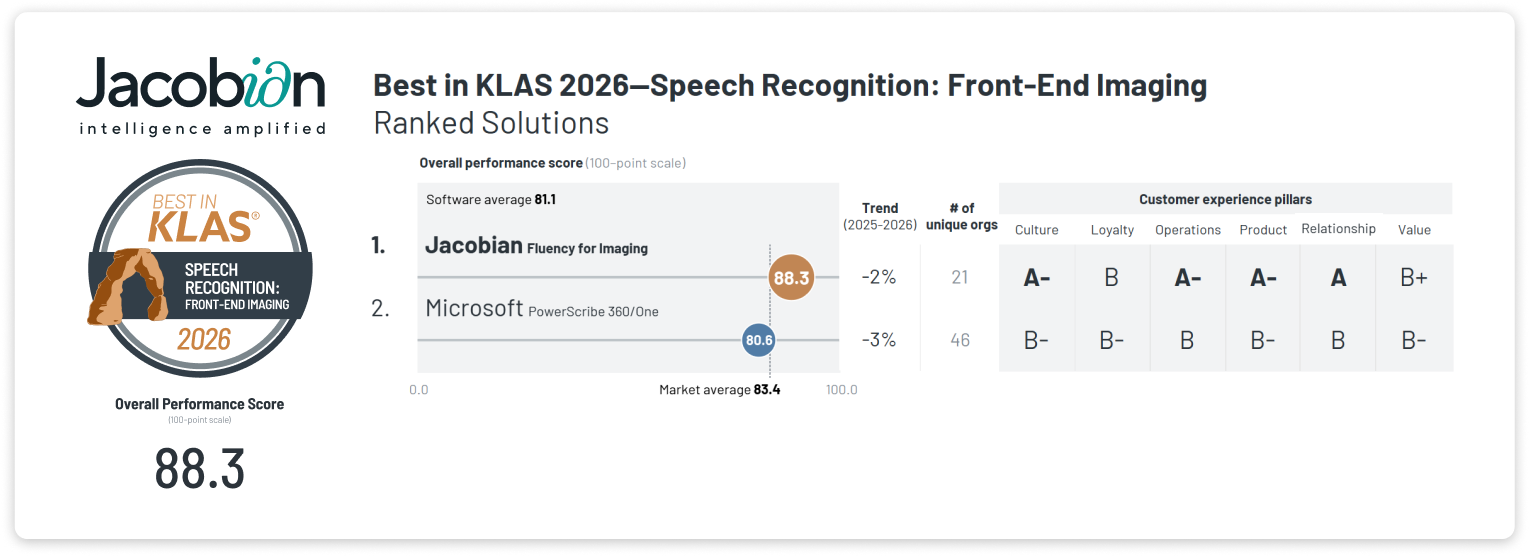
1. Not a feature ranking
KLAS does not score roadmaps or marketing claims. It measures real-world customer experience: reliability, usability, trust, and outcomes.
Reliability and usability are not abstract criteria - they show up in daily workflow performance:
"Fluency for Imaging is efficient. It has very good recognition. It is very easy to use and has a lot of templates that the doctors can add. We have faster dictation and turnaround time for the reports."
- Analyst/Coordinator, September 2025 - collected by KLAS Research.
Ease of use, strong recognition, and measurable improvements in turnaround time are exactly the types of outcomes KLAS interviews aim to surface.
2. Built entirely on customer voice
Scores are based on:
- Standardized 1–9 satisfaction ratings
- Yes/No trust and loyalty questions
- In-depth qualitative interviews
No analyst weighting. No vendor input.
Because the methodology relies fully on customer experience, partnership and service quality naturally become part of the evaluation:
"Fluency for Imaging has been great... [Jacobian] has been great at working with me through customer service on issues that I haven't been able to resolve. They are just a great vendor."
- Manager, September 2025 - collected by KLAS Research
And long-term satisfaction often reflects consistent support across organizational levels:
"The radiologists have historically been very happy with Fluency for Imaging's dictation recognition. … The support has always been absolutely phenomenal from the account-manager level all the way through to the developer level."
- Manager, October 2025 - collected by KLAS Research
3. Categories matter more than the headline score
The overall number aggregates dimensions such as:
- Culture (keeps promises, works as promoted)
- Operations (ease of use, training, implementation)
- Product (functionality, integration, innovation delivery)
- Relationship & Value (support, executive involvement, money’s worth)
- Loyalty (buy again, long-term plans)
Understanding where a solution is strong or under pressure is key. In practice, that strength becomes visible when clinical teams express sustained confidence in both product performance and collaboration.
4. Why Yes/No questions are critical
Questions like "Would you buy again?" or "Is it part of your long-term plans?" capture strategic confidence, not just satisfaction. Strategic confidence becomes particularly clear when customers speak about the future:
"I just want to give kudos to everyone I have worked with on support and development teams... Our higher-ups are looking forward to a good future with [Jacobian] and AI."
- Analyst/Coordinator, October 2025 - collected by KLAS Research
Such statements go beyond operational satisfaction. They indicate trust in long-term direction and innovation capacity.
5. Read the quotes - and act on them
Customer quotes explain why scores move.
For us, they are not commentary but input for product decisions - helping us translate real-world feedback into the right priorities for future development. Best in KLAS is not an award - it's a continuous reality check. The real insight lies beyond the score, in the customer experience that shapes what comes next.