The future of enterprise imaging won’t be shaped by technology alone. It will be shaped by the people who challenge convention, rethink what’s possible and turn new ideas into better ways of working.
Dr. Yeang Chng, MD PhD, Radiologist at Spectrum Healthcare Partners and Northern Light Health
How critical are platform accuracy and reliability in your reporting workflows?
Dr. Chng: "We’ve been on Jacobian Fluency for Imaging for the last eight years and we have been very impressed with the reliability of the product. It’s been rock solid in our experience. We’ve been through PACS system changes, we’ve been through data center shifts and many other things, and Fluency for Imaging is one of those things that just keeps trucking along reliably. One of the main things that has always impressed us is how accurate the voice recognition is."
When every second and every click matters, what role does technology responsiveness play in your daily workload?
Dr. Chng: "One of the other things that has been very impressive is the split second responsiveness. When we use competing products, sometimes there’s a lag of 300, 500 milliseconds doing common things like going from field to field, turning on your microphone, that results in part of your audio being cut off. That leads to mistakes, and no matter how many additional fancy features you have to improve efficiency, if you’re making mistakes like that, it almost gets rid of the efficiency gains you would have gotten. And radiologists notice, when they go and use competing products, it’s immediately one of the things that they note is that you don’t have the split-second responsiveness that you get with every function in Fluency for Imaging."
AI is ubiquitous in enterprise imaging. But does every AI application support efficiency and quality?
Dr. Chng: "We always have the conundrum of having many AI packages that we use in tests and a lot of them don’t really result in much productivity gain. Sometimes you spend more time reviewing the AI results than you actually save by what the AI package gives you. The Jacobian impression generator is one of those things where there is a very clear gain in efficiency and productivity. Not only that, it helps improve your clinical accuracy because sometimes you’ll forget to mention the incidental thyroid nodule that you described in the beginning of the study, and the impression generator catches it, puts it in."
Innovation is as much of a buzz word as AI is diagnostic imaging. But does it matter if the foundation is not strong and stable?
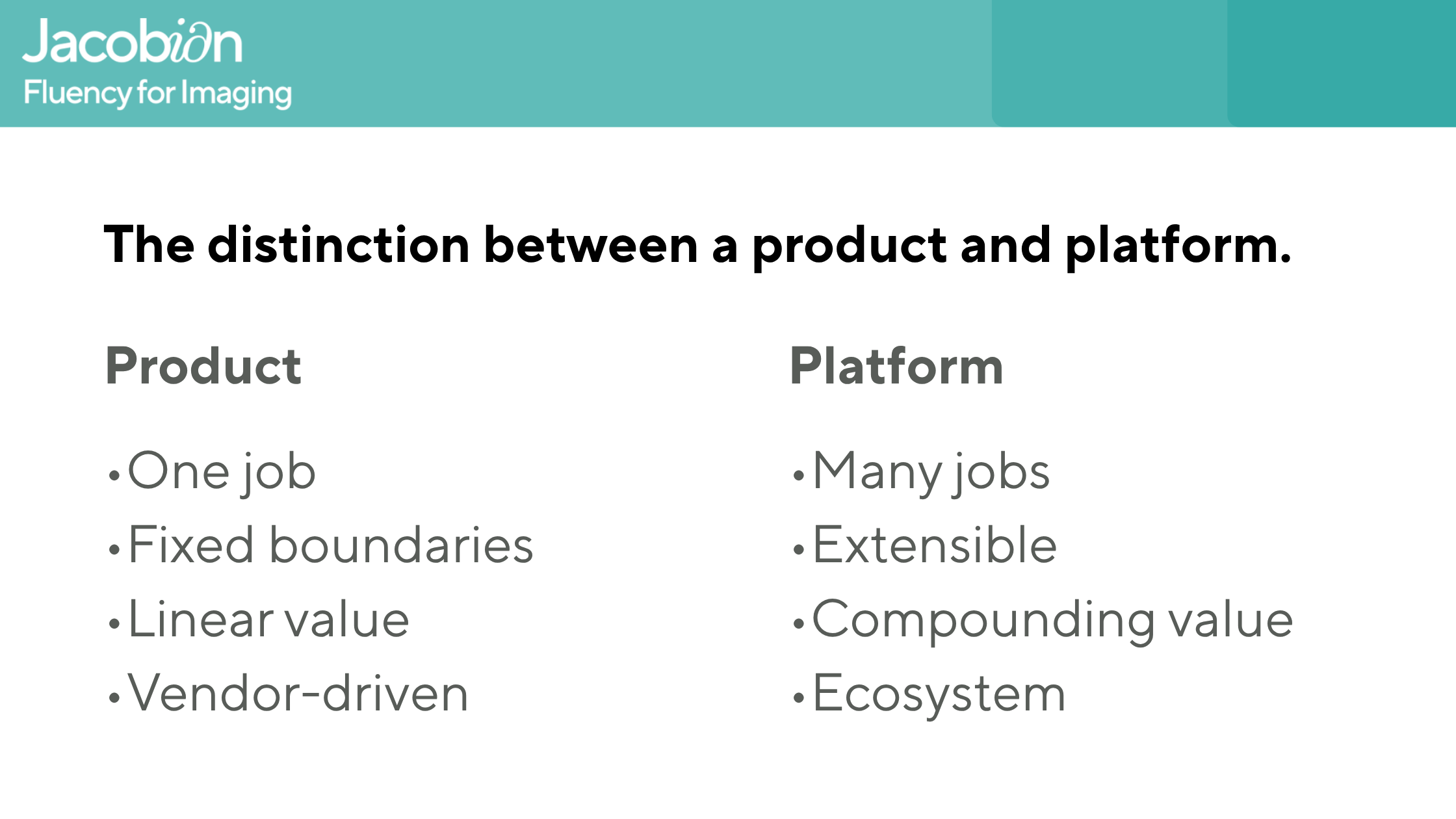
Dr. Chng: "It’s easy to focus on new features, but the core of it is that Fluency for Imaging has by far the best voice recognition accuracy of anything that we’ve used. … I think the base structure of Fluency for Imaging is set up remarkably well to help our efficiency and clinical performance. Templates, voice cues, things like that have been a part of our practice. We’ve used these extensively for the last eight years."
What is your tip for rolling out new platform capabilities responsibly, without adding friction or risk?
Dr. Chng: "We have this dual port system that allows the majority of the radiologists, cardiologists, clinical users to stay on a production port. But then there is a second port where we can have new features, beta features or advanced release or the next release that we are going to deploy. This is very different from just a test server. Because of this dual port system, we are able to roll things out to a select number of radiologists who are relatively good testers. With Fluency for imaging, we can have a full release available to play with on an advanced level but not have it impact the rest of the people throughout the enterprise until we are sure that it’s ready to be deployed."